
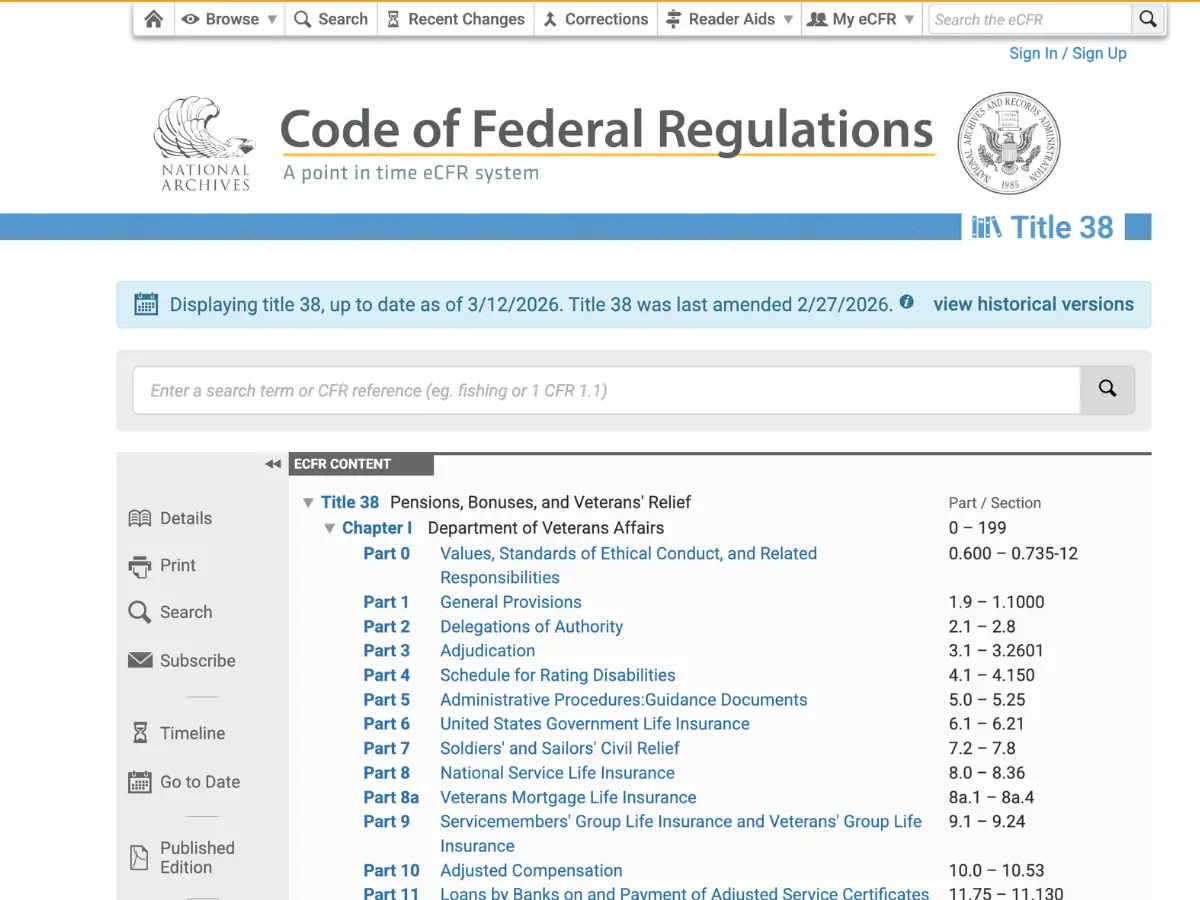
What is 38 CFR? It is the section of federal regulations that explains how the Department of Veterans Affairs must evaluate disability claims and apply the law when deciding veterans’ benefits. Title 38 of the Code of Federal Regulations, commonly called 38 CFR, governs how the VA determines service connection, assigns disability ratings, evaluates evidence, and processes appeals.
While many veterans hear about things like VA ratings, service connection, or C&P exams, those decisions are actually based on rules found inside 38 CFR.
This set of regulations explains how the VA must apply federal law when processing veterans’ benefits claims.
Understanding 38 CFR can help veterans better understand:
• how the VA determines service connection
• how disability ratings are assigned
• how evidence is evaluated
• how appeals work
In this guide, we’ll explain what 38 CFR is, where it came from, and how veterans can use it as a free resource.
What Is 38 CFR?
38 CFR (Title 38 of the Code of Federal Regulations) contains the official regulations governing veterans’ benefits.
These regulations are written and published by the Department of Veterans Affairs to explain how federal law related to veterans benefits should be applied.
In simple terms:
Congress writes the law governing veterans benefits in Title 38 of the United States Code.
The VA then creates regulations explaining how those laws should be implemented. Those regulations are published in 38 CFR.
VA employees must follow these regulations when processing claims, assigning disability ratings, and deciding appeals.
How the VA Claims Rule System Works
Veterans benefits decisions are based on a hierarchy of rules.
At the top are federal laws passed by Congress, found in Title 38 of the U.S. Code.
Next come VA regulations, which are published in 38 CFR. These regulations explain how the laws should be applied.
Finally, the VA publishes internal procedures such as the M21-1 manual, which explains how employees should apply those regulations when reviewing claims.
You can think of it this way:
Federal Law (Title 38 U.S. Code)
↓
VA Regulations (38 CFR)
↓
VA Procedures (M21-1 Manual)
The regulations in 38 CFR are legally binding, meaning the VA must follow them when making decisions.
When 38 CFR Started
The Code of Federal Regulations was first organized in 1938 as a centralized way to publish rules created by federal agencies.
Title 38 was established to contain regulations related specifically to veterans benefits and services.
Since then, 38 CFR has been expanded many times as new legislation, court decisions, and policy changes have affected veterans benefits.
Today, it remains the primary regulatory authority guiding how the VA processes claims.
Why 38 CFR Matters for VA Disability Claims
When the VA decides a disability claim, it must apply the regulations found in 38 CFR.
These regulations define many of the core rules governing the VA disability system.
Examples include:
Service connection rules
Presumptive conditions
Evidence requirements
Rating criteria for disabilities
Appeals procedures
Because these regulations have legal authority, they often play a key role during appeals or disputes over VA decisions.
Key Sections of 38 CFR Veterans Should Know
38 CFR is a large set of regulations, but a few sections are especially important for veterans filing disability claims.
38 CFR Part 3 – Adjudication
This section covers many of the core rules governing VA claims, including:
• Service connection requirements
• Presumptive service conditions
• Evidence rules
• VA’s duty to assist claimants
Many of the most important claim rules veterans encounter come from this section.
38 CFR Part 4 – Schedule for Rating Disabilities
This section contains the VA rating schedule used to determine disability percentages.
Each condition has specific rating criteria that determine whether a veteran receives compensation at levels such as:
10 percent
30 percent
50 percent
70 percent
100 percent
Understanding Part 4 can help veterans understand how disability ratings are assigned.
38 CFR Part 20 – Appeals Process
This section outlines the rules governing appeals within the VA system, including procedures used by the Board of Veterans’ Appeals.
It explains how veterans can challenge decisions and pursue further review when they disagree with a VA determination.
How Veterans Can Use 38 CFR
Although 38 CFR was written primarily for legal and administrative purposes, veterans and advocates often use it to better understand their benefits.
Here are some ways it can be helpful.
Understanding Rating Criteria
Many veterans want to know what evidence is required to reach certain disability ratings. The rating schedule in Part 4 explains the medical criteria used to assign ratings.
Understanding Service Connection Rules
Part 3 explains the requirements for establishing service connection, including direct service connection, secondary service connection, and presumptive conditions.
Understanding Evidence Requirements
The regulations also describe the VA’s duty to assist veterans in obtaining evidence and developing claims.
Understanding the Appeals Process
The appeals regulations explain how veterans can request review of decisions through higher-level review, supplemental claims, or appeals to the Board.
Where to Access 38 CFR for Free
The full text of 38 CFR is publicly available online.
You can access it here:
Electronic Code of Federal Regulations
You can also browse Title 38 directly through the Government Publishing Office website.
Both resources provide the official regulatory text used by the VA when deciding claims.
When Veterans May Want Additional Help
While 38 CFR provides the legal framework for VA benefits decisions, it can be difficult to navigate without guidance.
The regulations contain hundreds of pages of legal language and technical rules.
Many veterans find it helpful to get assistance organizing evidence and preparing claims.
If you are preparing a disability claim, you may want to learn more about the Operation Veterans Edge VA Disability Claim Program, which helps veterans organize evidence and prepare strong claims.
Some veterans may also qualify for the VA Aid and Attendance benefit, which provides financial assistance for certain long-term care needs.
In some cases, veterans may need professional medical documentation to support their claims, such as:
Nexus letters
Disability Benefits Questionnaires (DBQs)
Medical evaluations
Medical record reviews
These services are available through Stern HealthWorks, and veterans can access them whether or not they participate in Operation Veterans Edge.
Why This Resource Matters
The VA disability system can often feel confusing.
Understanding the regulations in 38 CFR helps veterans see the legal rules the VA must follow when processing claims.
When veterans understand these regulations, they are better positioned to prepare strong claims, understand rating decisions, and navigate the appeals process.
Bottom Line
38 CFR contains the official regulations governing VA disability claims and veterans benefits.
These regulations explain how federal law should be applied when the VA processes claims, evaluates evidence, and assigns disability ratings.
For veterans who want to better understand the legal framework behind the VA benefits system, it is one of the most important free resources available.